

Runtime Hooks
This page explains MASFactory runtime hooks: lightweight, in-process callbacks that you can attach to nodes/edges for logging, metrics, tracing message flows, and integrating with observability/debug tooling—without changing business logic.
Source references: masfactory/utils/hook.py, masfactory/core/node.py, masfactory/core/edge.py, masfactory/components/graphs/base_graph.py
1) What hooks are
MASFactory hooks are lightweight, synchronous, in-process events:
- Lightweight: no external middleware—just
dispatch(...)at key call sites. - Synchronous: callbacks run in the same thread; exceptions from hooks will interrupt execution (so make hooks defensive).
- In-process: ideal for logs/metrics/debug traces; cross-process communication is possible but must be done inside the hook (WebSocket/HTTP/etc.).
2) Available hook points (Node + Edge)
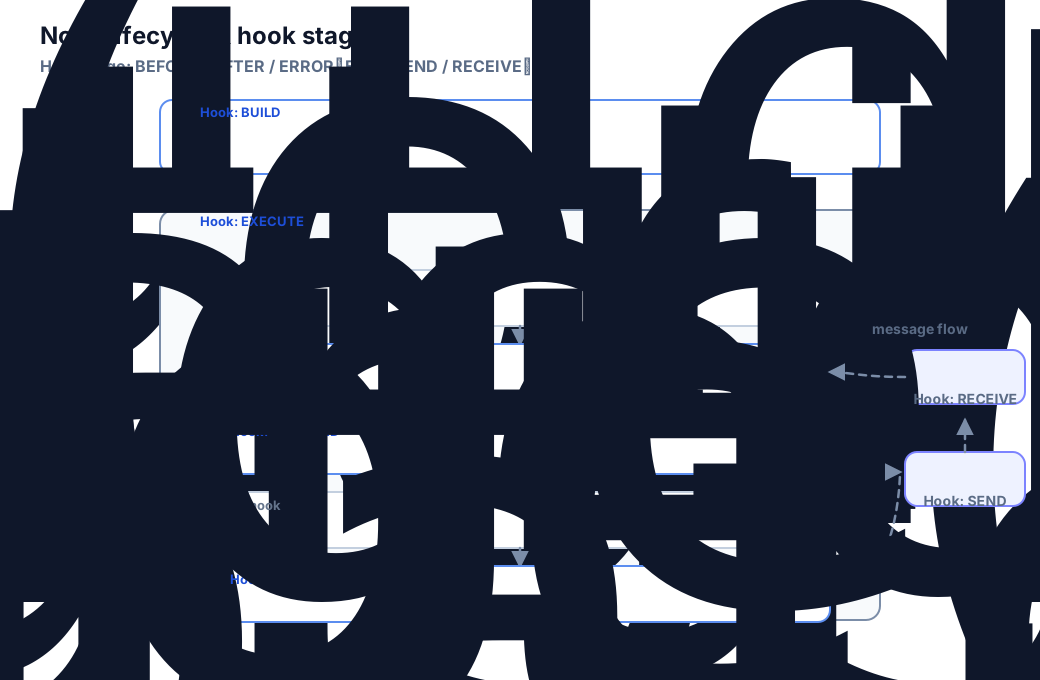
2.1 Node HookStage (BEFORE / AFTER / ERROR)
Node.Hook.* are HookStages. Each stage provides:
*.BEFORE: fired before the call*.AFTER: fired after return (includes the return value)*.ERROR: fired on exception (includes the error)
Common stages:
Node.Hook.BUILD: duringbuild()Node.Hook.EXECUTE: duringexecute()(the overall scheduling entry)Node.Hook.MESSAGE_AGGREGATE_IN:_message_aggregate_in()Node.Hook.FORWARD:_forward(input)(core computation)Node.Hook.MESSAGE_DISPATCH_OUT:_message_dispatch_out(output)
Note
EXECUTEhooks always exist becauseNode.execute()is decorated in the base class.FORWARDhooks only fire if the implementation uses@masf_hook(Node.Hook.FORWARD)(built-in components do; custom nodes should add it explicitly).
2.2 Edge event hooks (SEND / RECEIVE)
Edges expose two event points (not HookStage, so no BEFORE/AFTER/ERROR split):
Edge.Hook.SEND_MESSAGE: fired aftersend_message(...)Edge.Hook.RECEIVE_MESSAGE: fired whenreceive_message()consumes the buffered message
Typical uses: message tracing, auditing, distributed correlation, etc.
3) Registering hooks
3.1 Register on a single node
from masfactory.core.node import Node

def before_forward(node: Node, input: dict):
    print(f"[{node.name}] input keys: {list(input.keys())}")

def after_forward(node: Node, output: dict, input: dict):
    print(f"[{node.name}] output keys: {list(output.keys())}")

node.hook_register(Node.Hook.FORWARD.BEFORE, before_forward)
node.hook_register(Node.Hook.FORWARD.AFTER, after_forward)
3.2 Register recursively on a whole graph (recommended)
from masfactory.core.node import Node
from masfactory.components.graphs.root_graph import RootGraph

def trace_execute(node: Node, outer_env: dict | None):
    print(f"[EXECUTE] {node.name}")

graph = RootGraph("demo")
graph.hook_register(Node.Hook.EXECUTE.BEFORE, trace_execute, recursion=True)
3.3 Filter by selector (target_type / target_names / target_filter)
from masfactory.components.agents.agent import Agent
from masfactory.core.node import Node

def only_agents(node: Node, input: dict):
    print(f"[AGENT] {node.name}")

graph.hook_register(
    Node.Hook.FORWARD.BEFORE,
    only_agents,
    recursion=True,
    target_type=Agent,
)
4) Callback signatures (important)
HookStage dispatches arguments in a fixed order:
BEFORE:(self, *original_args, **original_kwargs)AFTER:(self, result, *original_args, **original_kwargs)ERROR:(self, err, *original_args, **original_kwargs)
Example: for Node._forward(self, input), the AFTER hook signature should be:
def after_forward(node, output, input):
    ...
5) Example: tracing message flow (Edge hooks)
from masfactory.core.edge import Edge
from masfactory.core.node import Node

def on_send(sender: Node, receiver: Node, message: dict):
    print(f"{sender.name} -> {receiver.name}: {list(message.keys())}")

graph.hook_register(Edge.Hook.SEND_MESSAGE, on_send, recursion=True)
6) Custom nodes: enabling FORWARD hooks
If you implement a custom node and want Node.Hook.FORWARD.* hooks to fire, decorate _forward explicitly:
from masfactory.core.node import Node
from masfactory.utils.hook import masf_hook

class MyNode(Node):
    @masf_hook(Node.Hook.FORWARD)
    def _forward(self, input: dict) -> dict:
        return {"ok": True}