

First Code (0 → 1)
Goal: write a runnable MASFactory workflow in minutes and understand the essential APIs: RootGraph / Node / Edge / build / invoke.
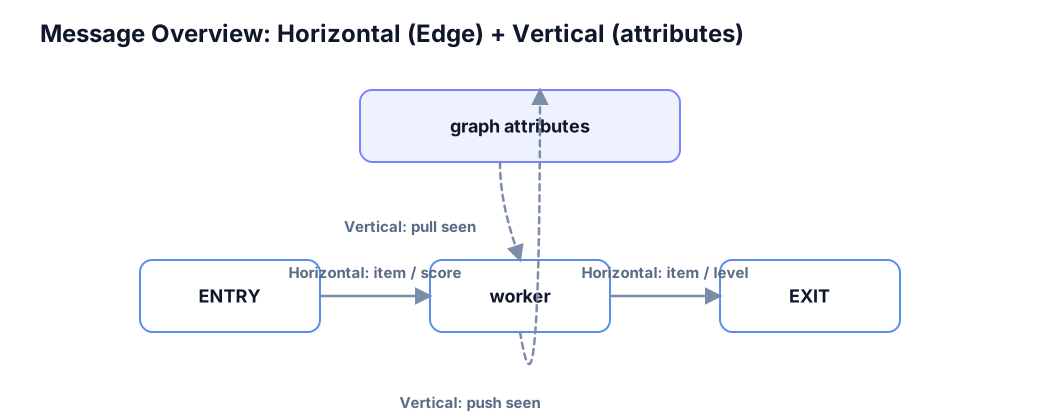
0) Two concepts to understand first
- MASFactory uses Python
dictas the message carrier. Inputs, node outputs, and edge payloads are all structured asdict. The smallest unit of message exchange is a single field in that dict.
- Horizontal message passing: nodes exchange payloads through
Edgeinside the same graph.Edge.keysdefines the field contract and routing rule (“which fields flow across this hop”). - Vertical message passing: a node exchanges state with its containing graph through
attributes(node attributes).pull_keys / push_keysdecide which fields are read from / written back toattributes. - For details, see: Message Passing.
RootGraph.invoke(...)returns a tuple:(output_dict, attributes_dict). The first item is the final output of horizontal passing; the second item is a snapshot of the graph attributes (vertical state).
Diagram: Horizontal (Edge) + Vertical (attributes)
1) Your first Agent workflow
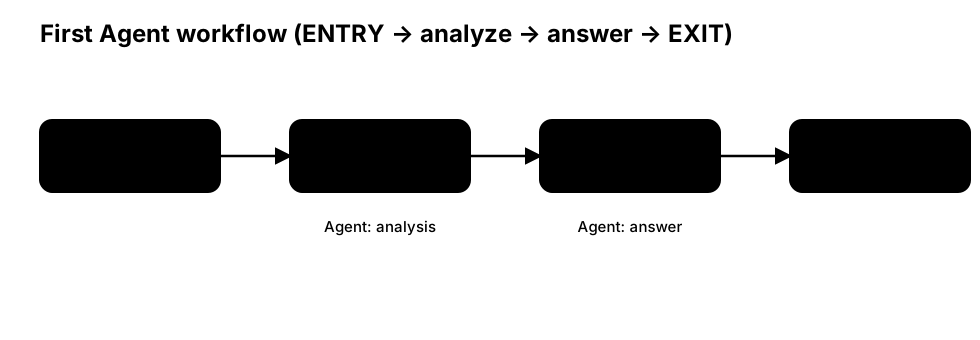
We build a simple QA workflow with two agents: one for analysis and one for answering.
Diagram: analyze → answer
python
from masfactory import RootGraph, Agent, OpenAIModel, NodeTemplate, HistoryMemory

model = OpenAIModel(
    api_key="YOUR_API_KEY",
    base_url="YOUR_BASE_URL",
    model_name="gpt-4o-mini",
)

history = HistoryMemory(top_k=12)
BaseAgent = NodeTemplate(Agent, model=model, memories=[history])

g = RootGraph(
    name="qa_two_stage",
    nodes=[
        ("analyze", BaseAgent(instructions="You are a problem analysis expert.", prompt_template="User question: {query}")),
        ("answer", BaseAgent(instructions="You are a solution expert. Provide the final answer based on the analysis.", prompt_template="Question: {query}\nAnalysis: {analysis}")),
    ],
    edges=[
        ("entry", "analyze", {"query": "User question"}),
        ("analyze", "answer", {"query": "Original question", "analysis": "Analysis result"}),
        ("answer", "exit", {"answer": "Final answer"}),
    ],
)

g.build()
out, _attrs = g.invoke({"query": "I want to learn Python. Where should I start?"})
print(out["answer"])
Read model config from environment variables
MASFactory does not auto-load environment variables. You can wire them in yourself:
python
import os
from masfactory import OpenAIModel

model = OpenAIModel(
    api_key=os.getenv("OPENAI_API_KEY", ""),
    base_url=os.getenv("OPENAI_BASE_URL") or None,
    model_name=os.getenv("OPENAI_MODEL_NAME", "gpt-4o-mini"),
)
Why doesn’t an Agent read attributes by default?
Agent.pull_keys / Agent.push_keys defaults to {}. With this setting, an agent does not read from or write back to graph attributes.
If you want an agent to read from attributes, explicitly set pull_keys to the required fields. If you set pull_keys=None, it will inherit all attributes.
3) What to read next?
- For a systematic understanding of declarative orchestration: read the Development Guide and Examples.
- For runnable side-by-side comparisons: run
examples/run_all.pyin this repo (includes Imperative vs Declarative comparisons).